Part 08 · Field Book
Generative Methods
How to start and keep going — constraints, chance, systems, collaboration, iteration, improvisation, failure.
The myth of the blank canvas assumes that art begins with a surplus of freedom, yet for most practitioners, the primary obstacle is the paralysis of infinite choice. Generative methods provide the necessary friction to overcome this inertia, replacing the fickle mechanism of inspiration with the structural rigor of systems, constraints, and curated accidents. By adopting specific protocols—whether through the cold logic of chance, the theft of appropriation, or the productive frustrations of failure—the artist shifts from the role of a solitary visionary to that of a tactician, orchestrating the conditions under which a work might finally insist upon its own existence.
In this part · 10 chapters
Constraints & limitations
The fundamental paradox of the creative act is that absolute freedom is often indistinguishable from paralysis. When an artist is confronted with an infinite field of possibilities—any subject, any medium, any scale—the weight of choice can settle into a profound inertia. We mistake the absence of boundaries for liberty, yet without a container, the creative impulse tends to dissipate. It is through the imposition of artificial limits that attention is focused and the engine of invention is actually engaged. Constraints do not stifle the imagination; they provoke it, forcing the artist to find a way around a barrier that cannot be moved.
The psychological efficacy of the constraint lies in its ability to bypass the ego’s desire for perfection. When we work under a severe limitation—using only three colors, or finishing a piece within a strict hour—the "ideal" version of the work becomes impossible. This failure is liberating. Released from the burden of making a masterpiece, the artist is free to experiment. Decisions that would otherwise drain mental energy are made in advance by the rules of the game, preserving the artist’s stamina for the actual labor of problem-solving.
History suggests that some of the most rigorous creative breakthroughs have occurred within self-imposed silos. In 1995, the filmmakers of the Dogme 95 movement, led by Lars von Trier and Thomas Vinterberg, drafted a "Vow of Chastity" that forbade sets, props, artificial lighting, and even directorial credit. The goal was a radical naturalism, a stripping away of the cinematic "trickery" that had become a crutch. While the movement eventually dissolved, and some of the resulting films were more endurance tests than art, the experiment proved that a director forced to use a handheld camera in a real room could find a visceral truth that a big-budget production might miss.
This impulse toward the generative rule is perhaps most visible in the literary experiments of Oulipo, or the Ouvroir de littérature potentielle. Writers like Georges Perec turned restriction into a mathematical engine; Perec famously wrote an entire novel, A Void, without the letter "e." In his later masterpiece, Life: A User’s Manual, he structured the narrative according to the "knight's tour" on a chessboard. These were not mere gimmicks; they were ways of outsmarting the writer’s own habits. By making the obvious choice illegal, the constraint forces the creator to find the unexpected one.
In the visual arts, Minimalism operated on a similar logic of subtraction. By limiting their vocabulary to geometric forms and industrial materials—Donald Judd’s steel boxes or Dan Flavin’s fluorescent tubes—these artists discovered a vast territory within a very narrow bandwidth. They realized that when the "what" is simplified, the "how" becomes monumental.
The Architecture of Limitation
Constraints can be categorized by the specific friction they introduce to the process. Material constraints are perhaps the most immediate, often involving a winnowing of the palette or a restriction to found objects. To work only with scrap metal or paper is to stop looking for the "right" material and to start investigating the soul of what is already there. Similarly, temporal constraints—the "deadline" or the "timed sprint"—defeat the habit of overthinking. A painting finished in twenty minutes possesses a nervous energy that a month of labor can easily polish away.
Formal and procedural constraints move the work into the realm of the systemic. One might commit to a grid, as the Modernists did, or to a specific geometric vocabulary. Or one might adopt an algorithmic approach, as Sol LeWitt did with his wall drawings, where the artist provides the instructions and the execution is left to assistants or chance. This echoes the "chance operations" of John Cage, who used the I Ching to determine musical compositions, effectively removing his own taste from the equation. When we use the "wrong" hand to draw, or refuse to erase a single line, we are intentionally breaking our own virtuosity to see what survives the wreckage.
The effectiveness of these rules depends on a certain "sweet spot" of difficulty. As Mihaly Csikszentmihalyi noted in his studies on "flow," optimal engagement occurs when the challenge of a task perfectly matches the skill of the performer. A constraint that is too loose—such as "use any color you like"—provides no resistance and thus no spark. A constraint that is too rigid—"paint a mural using only a single eyelash"—may become a feat of stamina rather than a creative act. The most productive discomfort happens just beyond the edge of one’s comfort zone. For a beginner, a limited palette of primary colors is a revelation; for a master, it may be a retread of old ground, requiring a more esoteric challenge to reawaken the senses.
Ultimately, the use of constraints is a method of primary research. By choosing a single subject—as Giorgio Morandi did with his endlessly rearranged bottles, or Paul Cézanne with the rugged profile of Mont Sainte-Victoire—the artist discovers that depth is the result of sustained attention rather than variety. To draw the same object thirty times is not a repetitive act but a cumulative one. Each iteration strips away a layer of preconception until, finally, we stop seeing what we think is there and begin to see what is actually there. The rule is not a cage; it is a lens.

Still Life with Apples, c. 1893–94
Paul Cézanne · Oil on canvas
Constraint as method: the same fruit on the same cloth, painted until the ordinary arrangement becomes a laboratory for colour and structure.
The J. Paul Getty Museum, Los Angeles · Source
Diagnostic questions: Impose one new constraint on your next piece — one colour, one hour, one surface, one gesture. What did the constraint force you to invent that freedom wasn't producing?
Randomness & chance
If the use of constraints is an act of narrowing the field of vision to sharpen focus, the introduction of randomness is an act of total surrender. Where the formalist seeks to master the canvas, the artist engaging with chance seeks to be decentered by it. This is not merely an aesthetic strategy; it is a displacement of the ego. We all carry a repertoire of comfortable habits—the predictable flick of the wrist, the favorite palette, the compositional structures we lean on when we are tired. These are the walls of the self. To invite chance is to breach those walls, allowing the world to participate in the making. It is a transition from authorship to co-authorship with physics, gravity, and time.
The philosophical pedigree of this approach is long and varied. In the early twentieth century, the Dadaists and Surrealists looked to randomness as a way to bypass the rational, bourgeois mind and tap into the raw mechanics of the unconscious. For Jean Arp, this took the form of his Collages Arranged According to the Laws of Chance (1916–17), created by dropping scraps of paper onto a surface and gluing them where they fell. The underlying belief was that the universe possessed a latent order more profound than any man-made arrangement. This resonates with the Zen and Taoist concepts of wu wei, or effortless action, where the practitioner flows with natural processes rather than struggling against them. Perhaps no one articulated this more clearly than John Cage, who applied the hexagrams of the I Ching to determine the structure of his music. By using coin tosses to decide duration and pitch, as in his Music of Changes (1951), Cage sought to let sounds "be themselves" rather than vehicles for his own emotions.

Inkblot No. 1, from Psychodiagnostik, 1921
Hermann Rorschach · Symmetrical inkblot print
Chance folded into symmetry: an accidental spill converted into a formal object that the mind cannot look at without immediately reading a figure into it.
Public domain diagnostic plate · Source
The Mechanics of Uncertainty
In the studio, randomness can be introduced through a spectrum of physical and systemic methods. Some, like the use of dice, cards, or algorithms, are procedural. By assigning colors to a deck of playing cards or mapping compositional coordinates to the roll of a die, the artist abdicates the "rightness" of their own taste. The result is often a dissonant or surprising combination that the conscious mind would have filtered out as "incorrect." In the digital realm, this survives in the form of generative code and algorithmic art, where parameters are set by the programmer but the specific execution is left to a random number generator. Even the "glitch"—the exploitation of a software error or a corrupted file—functions as a modern equivalent to the smudged ink or the stray drip.
Physical chance, however, remains the most visceral application of this theory. When Jackson Pollock moved his canvas to the floor and abandoned the brush for the drip, he was not losing control so much as shifting its location. The work became a record of momentum, viscosity, and gravity. Helen Frankenthaler’s soak-stain technique operated on a similar principle: by pouring thinned pigment onto raw canvas and tilting the support, she allowed the paint to find its own level, staining the fibers in ways that no brush could replicate. The artist initiates the event, but the fluid dynamics of the medium carry it to its conclusion.
Environmental factors offer an even more radical abandonment of control. Artists like Andy Goldsworthy build structures out of ice, leaves, or stone, knowing that the tide, the wind, or the sun will eventually dismantle them. The work is not just the object itself, but the process of its inevitable decay. To leave a painting outside to be weathered by rain or bleached by the sun is to accept nature as an active collaborator. It is a recognition of impermanence, a quiet admission that nothing we make is immune to the slow, random erosion of time.
Controlled Spontaneity
Despite the rhetoric of total surrender, most visual art that utilizes chance actually exists in a hybrid state of "controlled spontaneity." Very few artists are willing to accept every outcome without revision. Gerhard Richter’s large-scale abstract paintings are perhaps the most famous contemporary examples of this tension. By dragging a massive squeegee across layers of wet oil paint, Richter creates ruptures and smears that are entirely unpredictable. Yet, he is the one who chooses which layers to build, which colors to scrape, and when the accumulated accidents have finally reached a state of resolution. He curates the chaos.
This suggests two distinct modes of practice. The first is radical acceptance, where the artist keeps whatever the random process generates—a humbling, if sometimes dry, exercise in ego-dissolution. The second is selective acceptance, where chance is used as a generative spark to produce raw material that is then refined, edited, and shaped by the artist’s eye. This is the realm of the "happy accident," the term popularized by Bob Ross to describe those moments when a stray mark or an unintended bleed improves the work beyond the artist’s original intent.
To work with chance is to move away from the idea of the artist as a master-builder and toward a role more akin to that of a gardener. One prepares the soil, plants the seeds, and provides the water, but the specific curve of the vine and the exact moment of the bloom are left to forces that are, quite happily, beyond our command. In the end, these methods serve to remind us that the most interesting things in art—as in life—are often those we did not intend to happen.
Diagnostic questions: Where in your process are you making a decision that could just as well be delegated to a coin, a die, or a random number? Delegate it once and see if the work suffers, or if your ego does.
Systems & rules
The shift from intuition to the implementation of systematic rules marks one of the most significant pivots in twentieth-century practice. In this mode, the artist no longer acts as a romantic visionary waiting for a lightning strike of inspiration, but as an architect of logic. By establishing a set of predetermined constraints—a system—the artist effectively builds a machine to generate the work. The aesthetic result is not an end in itself, but the visible residue of a process being carried out to its logical conclusion.
Sol LeWitt stands as the paradigmatic figure of this shift. His wall drawings are not objects in the traditional sense; they are a series of instructions, such as his Wall Drawing #122, which dictates the combination of two lines crossing, using arcs from corners and sides, straight and broken lines. Because the work exists as a concept rather than a fixed physical entity, the execution can be handled by assistants. The resulting murals may vary depending on the texture of the wall or the slight interpretive differences of the draftsmen, yet they remain the same "artwork." As LeWitt famously noted, the idea becomes a machine that makes the art, effectively dematerializing the object and questioning the necessity of the artist’s hand.
This reliance on systems often finds its foundations in the cold certainty of mathematics. Artists have long employed sequences—such as the Fibonacci sequence, where each number is the sum of the two preceding it—to dictate intervals, proportions, or quantities within a composition. Others look to the decimal expansions of constants like Pi or the uneven rhythm of prime numbers to break the stagnation of symmetry. Hanne Darboven’s work pushed this numerical logic to the point of obsession, using calendar systems and exhaustive permutations to create vast, immersive installations of handwritten data. In these works, the system provides a shelter from the burden of choice; the artist is spared the agony of deciding "what comes next" because the sequence has already decided for them.
The grid functions as the most ubiquitous of these systems, providing a skeletal framework that can be populated with infinite variation. For Agnes Martin, the grid was a meditative pursuit, where hand-drawn pencil lines on canvas created a vibrating, subtle field that navigated the tension between rigid geometry and human imperfection. In a more industrial register, Andy Warhol and Carl Andre used modular repetition—thirty-two soup cans or a series of metal floor tiles—to emphasize the serial nature of modern existence. The grid does not merely organize space; it democratizes it, giving each module an equal weight and refusing the hierarchy of a central focal point.
With the advent of the computer, the logic of the system became literal code. Vera Molnár, a pioneer of generative art, began writing algorithms in the late 1960s, using the computer to explore the boundary between order and disorder. By introducing small, systematic variations into a program, she could generate thousands of drawings that the human hand could never produce with such tireless precision. This lineage continues in the work of contemporary practitioners like Casey Reas, where software instructions define the behaviors of digital agents, allowing a visual ecosystem to grow and evolve according to local rules of interaction.
Perhaps the most grueling application of the system is found in time-based, durational works. On Kawara’s Today series represents a lifelong commitment to a single rule: paint the current date on a canvas, and if it is not finished by midnight, destroy it. The work is a record of a life lived through the mechanism of a clock. Even more extreme is the practice of Tehching Hsieh, whose One Year Performances transformed his entire existence into the execution of a singular, often punishing rule. Whether punching a time clock every hour for a full year or living entirely outdoors without shelter, Hsieh’s work tests the limits of human endurance against the inflexibility of a conceptual system.
For the practitioner, the central tension in rule-based art lies between strict adherence and the temptation to intervene. A conceptual purist follows the system through to the end, accepting whatever emerges—whether it is boring, ugly, or sublime. To do otherwise is to revert to "taste," which the system was designed to bypass. However, many artists find value in the intentional violation of their own rules, creating moments of friction where the logic breaks down. This breach often highlights the system more effectively than perfect compliance would.
Ultimately, creating a system is an act of liberation through voluntary restraint. Whether one is translating a poem into a color code, exhausting all possible permutations of three shapes, or committing to a daily discipline for thirty days, the goal is to move the work beyond the narrow confines of one’s own immediate preferences. The system acts as a collaborator, one that is indifferent to the artist’s moods, pushing the work toward forms that a free and unburdened mind might never have the courage to choose.
Diagnostic questions: Write down the rule you're following, even if you didn't know you had one. Now write its opposite. What would the work look like if you followed the opposite for a week?

Melencolia I, 1514
Albrecht Dürer · Engraving
Systems as subject: Dürer piles up the instruments of measure — polyhedron, magic square, compass, scales — and asks whether rule-following alone is enough. A five-hundred-year-old picture of the generative artist's basic doubt.
Various collections · Source
Collaboration
The myth of the lone artist, suffering in a garret and communing strictly with the muse, is a persistent romantic fiction. In practice, art has always been a social act, a negotiation between the self and the world, and frequently a labor shared by many hands. To collaborate is to abandon the totalizing control of the solitary ego in favor of a wider, more unpredictable intelligence. At its best, this approach allows for a kind of creative alchemy: the conceptualist finds their technical foil; the painter finds a fabricator who can scale a gesture into a monument. It is a hedge against the myopia and inertia of working in a vacuum, providing not only an external source of accountability but a mechanism for the "cross-pollination" of ideas that one mind, left to its own devices, might never encounter.
Models of Shared Authorship
The structures of collaboration are as varied as the work they produce, ranging from total synchronicity to rigid hierarchies. At one end of the spectrum is the equal partnership, a fusion so complete that the individual identities of the creators become indistinguishable within the work. Since 1967, Gilbert & George have functioned as a single artistic entity, referring to themselves as "living sculptures" and presenting a unified front that renders their personal biographies secondary to their joint output. Similarly, the monumental temporary installations of Christo and Jeanne-Claude—the wrapping of the Reichstag or the placement of thousands of saffron gates in Central Park—were the result of a lifelong intellectual and logistical marriage. While early accounts often centered on Christo, the history was eventually corrected to reflect an absolute parity in their conceptual and migratory labor.
A different, perhaps more contentious model is the division of labor, which adopts the logic of the workshop or the factory. Here, the artist functions as a director or architect rather than a manual laborer. Andy Warhol’s "Factory" famously challenged the status of the "hand" in art, utilizing assistants to execute screen prints and films under his brand, effectively commodifying the process of production. Modern iterations of this model, such as the studios of Jeff Koons or Damien Hirst, take this to its logical conclusion: the artist may not touch the physical work for decades, acting instead as a conceptual manager of a large staff of highly skilled fabricators. This model remains polarizing; for some, it is the ultimate expression of the artist-as-thinker, while for others, it feels like a hollow abdication of the essential connection between maker and material.
Between these extremes lie methods of sequential or participatory collaboration. The Surrealist game of the Exquisite Corpse serves as the archetype for the former. By folding a piece of paper so that each contributor draws a section without seeing the one before it, the artists relinquish control to the whims of chance and collective unconscious. This "call and response" creates a visual conversation where every mark is a reaction to a previous statement. In more public-facing works, such as Yoko Ono’s instruction pieces or Felix Gonzalez-Torres’s diminishing piles of candy, the audience is invited to complete the work. The artist here is a facilitator of an event, an architect of an experience that requires the viewer’s participation to exist at all.
The Friction of the We
To work with another person is to inhabit a space of constant negotiation. It requires a move from the monologue of the studio to a dialogue that is often fraught with friction. Successful collaboration depends on a clear understanding of expectations—deciding at the outset how credit will be shared, how labor will be divided, and how the spoils of the work will be distributed. In the absence of such clarity, resentment is the most common byproduct. True collaboration requires the "yes, and..." principle of improvisational theater: the willingness to accept a collaborator’s contribution as a new reality and build upon it, rather than shutting it down to preserve one’s original vision.
Conflict is not only inevitable in this process but often necessary. When two creative registers clash, the resulting compromise can lead to solutions that neither artist would have arrived at alone. However, this productive tension requires a baseline of respect and a mechanism for breaking stalemates, whether through consensus or by deferring to the partner with the relevant technical expertise.
There is also the difficult art of knowing when a collaboration has reached its natural conclusion. Some partnerships are seasonal, existing to solve a specific problem or explore a temporary shared interest, while others may become stifling once the initial spark of discovery has dimmed. Ending a collaborative relationship gracefully is as much a part of the craft as the work itself. Ultimately, the value of making art with others lies in the way it forces the artist to see through another’s eyes—not to lose one's voice, but to hear how it resonates in a room that is no longer empty.
Diagnostic questions: Who is the last person you showed early, unfinished work to? If you can't remember, the practice has gone private in a way that's costing you. Who would you trust to see the next rough version?

January, from Les Très Riches Heures du duc de Berry, c. 1412–16
Limbourg brothers (Herman, Paul, and Johan) · Illumination on vellum
One of the great pictures made by three brothers together: proof that the myth of the solitary genius post-dates most of the objects the museums are built around.
Musée Condé, Chantilly · Source
Appropriation & remix
The claim that nothing is original—famously lamented in the Book of Ecclesiastes and later championed by the architects of Postmodernism—is not a counsel of despair, but a foundational principle of the generative process. To create is not to pull something from a vacuum of "pure" inspiration, but to engage in a sophisticated act of recombination. The Romantic myth of the artist as a solitary genius, an ex nihilo creator, has largely given way to a more honest recognition of our predicament: we are always already swimming in a sea of existing cultural materials, languages, and images. Appropriation is simply the act of acknowledging this lineage.
The legitimacy of the found object and the borrowed image was first codified in the early twentieth century. When Picasso and Braque glued scraps of newspaper and wallpaper onto their canvases in 1912, they were not merely saving time; they were rupturing the purity of the fine art tradition by forcing it to contend with the "real" world. This was pushed to its logical, if absurd, extreme by Marcel Duchamp’s readymades. By designating a mass-produced urinal or a bicycle wheel as art, Duchamp shifted the creative act from the hand to the mind—from making to choosing. If the artist’s primary work is the selection of context, then every object in the world becomes potential material.
By the mid-century, Pop Art had turned this lens toward the burgeoning consumer landscape. Andy Warhol and Roy Lichtenstein did not invent the Campbell’s soup can or the comic book panel; they appropriated them, elevating "low" commercial culture to the status of high art. In doing so, they revealed the iconography of the modern age. This evolved further in the 1970s and 80s with the Pictures Generation. Artists like Sherrie Levine, Richard Prince, and Cindy Sherman began to treat photography itself as a found object. When Levine re-photographed Walker Evans’ classic Depression-era photographs and titled them After Walker Evans, she staged a direct assault on the concepts of authorship and original genius. If a woman photographs a photograph taken by a man, who is the author? The gesture suggests that the "meaning" of an image resides not in its origin, but in its use.
The Mechanics of the Remix
There are several distinct modes through which an artist might recontextualize existing material. The most aggressive is détournement, a strategy championed by the Situationists in the 1950s. It involves hijacking the tools of the dominant culture—advertisements, comics, or films—and subverting them to reveal an underlying ideology. This lives on today in "culture jamming," where artists like Banksy or the editors of Adbusters magazine sabotage corporate logos to create anti-consumerist critiques. The goal is a visual "judo" move: using the weight of the original image against itself.
More common is the practice of sampling or transformative use. Here, the artist functions like a DJ, pulling fragments from disparate sources to build a new narrative. Romare Bearden’s collages utilized magazine cutouts and painted paper to evoke the rhythms of jazz and the complexities of African American life, turning fragmented media into a cohesive, lyrical whole. Similarly, Kara Walker appropriates the genteel aesthetic of Victorian silhouettes to depict the horrific violence of American slavery, using an antiquated form to expose a suppressed history.
A more contemporary iteration is the "mashup," exemplified by Kehinde Wiley. By placing contemporary Black subjects in the heroic poses of Old Master portraiture, Wiley does more than just copy a style; he critiques the entire history of Western art. The tension between the hip-hop fashion of the sitter and the ornate, floral backgrounds appropriated from historical textiles creates a powerful synthesis that asserts a presence previously excluded from the museum walls.
The Ethics of the Borrowed
To work with appropriated material is to walk a legal and ethical tightrope. In the United States, the primary defense is fair use, a flexible but frustratingly vague legal doctrine. For an appropriation to be legally defensible, it generally must be "transformative"—it must add new meaning, message, or purpose rather than simply acting as a substitute for the original. When Richard Prince re-photographed Marlboro advertisements, he arguably transformed corporate propaganda into a critique of American masculinity. However, his career has been marked by a series of high-profile lawsuits, illustrating that the line between "transformative use" and copyright infringement is often drawn by a judge’s temperament.
The case of Shepard Fairey’s Obama Hope poster serves as a cautionary tale. While the image became an icon of the twenty-first century, Fairey’s failure to credit the original Associated Press photograph—and his subsequent attempts to hide the source—led to a costly legal battle that tarnished the work’s legacy. Even Jeff Koons, one of the wealthiest living artists, has been a serial defendant in copyright cases, proving that neither fame nor deep pockets provide immunity from the laws governing intellectual property.
Beyond the courtroom, however, lies the more nuanced realm of ethics. One must consider the power dynamics inherent in the act of borrowing. To appropriate from "above"—to subvert the imagery of powerful corporations or dominant cultural institutions—is often viewed as a form of justified critique. To appropriate from "below"—taking from marginalized communities or less powerful individuals without credit or compensation—is frequently indistinguishable from exploitation.
The serious practitioner should ask whether the appropriation is necessary for the work's intellectual or emotional core. If the aim is genuine commentary, the act is often justified. If the aim is merely to bypass the labor of creation, it is likely a failure of imagination. Transparency is often the best policy; acknowledging sources in artist statements or titles does not weaken the work. Instead, it invites the viewer into the conversation, revealing the art for what it truly is: a new link in a very old, very long chain.
Diagnostic questions: For the source you're borrowing from, can you say — in one sentence — what the borrowing adds that the original didn't have? If not, it's decoration, not appropriation.

Le Déjeuner sur l'herbe (Luncheon on the Grass), 1863
Édouard Manet · Oil on canvas
Appropriation as public argument: Manet lifts the seated group directly from a Raimondi engraving after Raphael, puts them in modern clothes beside a naked woman, and lets the scandal be the meaning.
Musée d'Orsay, Paris · Source
Iteration & variation
The myth of the singular masterpiece—the solitary work that emerges fully formed and final—is one of the most persistent and damaging fictions in the history of art. It suggests that the artist arrives at an image through a flash of lightning rather than a slow, often rhythmic process of accretion. In truth, the most profound insights in visual art rarely occur in the singular instance; they are found through iteration, the patient return to the same subject, form, or theme until the surface chatter falls away and the deeper structure reveals itself. Iteration is not merely repetition; it is a form of mining, where each successive version of a work digs deeper into a vein that a single pass could never exhaust.
There is a distinct psychological relief in working serially. When an artist commits to twenty versions of a form rather than one, the crushing weight of perfectionism begins to dissipate. If this specific canvas fails, there are nineteen others to carry the burden of the inquiry. This creates a space for a more daring kind of experimentation—a permission to fail that is essential for growth. Furthermore, iteration creates its own momentum. The transition from the fifth to the sixth version of a study carries the kinetic energy of what has already been learned, whereas starting a standalone work is, in many ways, an act of starting from zero.
We see this most clearly in the work of the great serialists, for whom the subject was often less a destination than a site of inquiry. Claude Monet’s various series—the haystacks, the poplars, and most notably the three dozen views of Rouen Cathedral—were not attempts to capture the appearance of the buildings themselves, but rather to document the transitive, fugitive nature of light and atmosphere. The cathedral remained stable; the light, however, was in constant flux. By holding the subject constant, Monet allowed the variable of time to become visible. Paul Cézanne performed a similar operation with Mont Sainte-Victoire, returning to the mountain more than sixty times. For Cézanne, the repetition was a struggle against the complexity of nature itself, a slow, methodical attempt to translate three-dimensional space into the logic of the two-dimensional plane. He famously noted that progress was "incessant," a word that implies not a finish line, but a continuous state of becoming.

Haystack, End of Summer, Morning, 1891
Claude Monet · Oil on canvas
The whole point of the Haystacks series: the object is fixed so that light, weather, and time of day can be the actual subjects.
Musée d'Orsay, Paris · Source
While Monet and Cézanne used iteration to investigate the natural world, others have used it to investigate the formal properties of art itself. Josef Albers’s Homage to the Square is perhaps the most systematic example of this in the twentieth century. By keeping the composition identical—a series of nested squares—Albers was able to isolate color as a purely relational phenomenon. In his thousands of variations, the "same" yellow might appear luminous in one context and sickly in another. This form of iteration is akin to a scientific experiment: by holding all variables constant except one, the artist gains a precise understanding of how that single variable functions. Similarly, the minimalist Sol LeWitt used geometric permutations to exhaust the possibilities of a simple form like the cube, proving that even the most rigid systems can yield an infinite variety of outcomes.
There is also a temporal dimension to iteration, where the repetition of a process becomes an act of marking life itself. On Kawara’s Today series—a decades-long practice of painting the current date in white on a monochromatic background—is a profound example of iteration as an ethical or existential stance. The work is not about the aesthetic quality of the typography, but the fact of the artist’s presence within the flow of time. Each painting is a record of a day lived. In a different vein, Allan McCollum’s Surrogate Paintings use iteration to critique the idea of the unique art object. By producing thousands of nearly identical objects through a standardized process, McCollum forces the viewer to confront the subtle, often accidental differences that emerge through the limits of material and the fallibility of the human hand.
The question of when to stop an iterative sequence is rarely answered by logic. It is usually a matter of intuition or exhaustion. A series is complete when the question that initiated it has been answered, or when the artist finds that they are merely repeating a gesture without discovering anything new. There is a point in every sustained exploration where the process can become rote or mechanical; this is the signal to depart. However, the risk for most is stopping too soon. A breakthrough often hides behind a wall of boredom or a string of seemingly "bad" works. It is often only after the tenth or twentieth variation that the superficial ideas are cleared away, allowing the work to speak in its true voice.
Developing a practice of iteration requires a shift in how one perceives the "good" work. Instead of judging each piece as a final verdict on one's talent, the artist must view each iteration as a stepping stone or a data point. To work in this way—to translate a single subject across different media, to observe the same object under shifting lights, or to methodically alter a single color variable—is to move from the amateur’s hope for a lucky strike to the professional’s mastery of the slow, inevitable reveal. Depth, in art, is almost always a function of time spent in the presence of the same problem.
Diagnostic questions: Make the same piece five times in a row, changing one variable each time. Which iteration is the strongest, and why? The answer is almost never the one you planned as the final.
Cross-pollination
The creative act is often treated as a closed loop, an internal dialogue between the artist and the history of their own medium. Yet the history of innovation suggests that the most profound shifts in visual art occur when the studio door is left open to the drafts of other disciplines. Within the "art bubble," ideas have a tendency to become self-referential and recycled, leading to a decorative stagnation where works are about other works of art. Cross-pollination—the deliberate importation of methods from science, music, literature, philosophy, and technology—acts as a corrective to this insularity. By adopting the rigor of a mathematician, the empirical curiosity of a biologist, or the structural logic of a composer, the artist finds new frameworks to replace tired conventions.
Science offers perhaps the most robust territory for this kind of extraction. In the realm of biology, artists like Brandon Ballengée and Suzanne Anker do not merely represent nature; they engage with its systems of growth, decay, and genetic mutation. Ballengée’s work with malformed frogs moves beyond mere illustration into an uneasy intersection of ecological activism and aesthetic inquiry. Similarly, the field of physics provides a lexicon for artists to manipulate the very mechanics of perception. James Turrell and Olafur Eliasson treat light and atmospheric conditions not as subjects to be painted, but as raw materials to be engineered—applying the principles of optics to create environments that challenge the viewer’s sense of space-time.
Even the seemingly inert world of chemistry becomes generative when framed as a process of transformation. Roger Hiorns’ installations, which utilize copper sulfate crystals to encase architectural structures, rely on chemical reactions rather than the artist’s hand to dictate form. This surrender to external laws—whether the chemical growth of Hiorns or the pollen-gathering of Wolfgang Laib—shifts the artist’s role from creator to facilitator. Similarly, the integration of mathematics and data visualization, seen in the algorithmic work of Casey Reas and the "mathematical sublime" of Ryoji Ikeda, replaces the romantic notion of intuition with the cold, generative power of the code and the fractal.
The Logic of Translation
If science provides the material and the method, music and literature provide the structure. The translation of musical concepts into visual form has a long, distinguished lineage, most notably in the work of Wassily Kandinsky and Paul Klee. For these artists, the relationship between color and harmony, or line and melody, was not merely metaphorical but a formal system of "visual polyphony." Contemporary practitioners like Christian Marclay continue this investigation by treating time itself as a medium, using cinematic fragments in The Clock to mirror the relentless, rhythmic progression of a twenty-four-hour cycle.
Literature offers a different set of tools, primarily those of narrative and the interrogation of language. The use of text in the work of Ed Ruscha, Barbara Kruger, or Glenn Ligon does not function as a caption but as a visual weight, often exposing the power structures inherent in words. When an artist like William Kentridge combines drawing, animation, and text, they are borrowing the "unreliable narrator" or the complex plot arc of the novel to give their work a temporal and moral depth that a static image might lack. There is also a rich vein of exploration in asemic writing—marks that mimic the form of language without carrying its linguistic meaning—as seen in the invented scripts of Xu Bing, which force the viewer to confront the limits of their own literacy.
Philosophy, too, serves as a scaffolding for visual inquiry. Minimalism and installation art owe a significant debt to phenomenology and the writings of Maurice Merleau-Ponty, focusing on how the body experiences space and embodiment. Conversely, the conceptual rigor of Adrian Piper and Joseph Kosuth draws directly from analytic philosophy and the linguistic investigations of Wittgenstein. Even the pursuit of "emptiness" or impermanence in the works of Agnes Martin or On Kawara reflects a visual translation of Zen and Daoist principles, where the act of making becomes a meditative record of existence rather than a bid for immortality.
The Technological Edge
The contemporary frontier of cross-pollination is found in the rapid evolution of technology and biotechnology. Artists are no longer just using tools; they are collaborating with autonomous systems. The work of Rafael Lozano-Hemmer or the robotic collaborations of Sougwen Chung demonstrate how sensors, actuators, and artificial intelligence can create a feedback loop between the human and the machine. In the more radical sphere of bio-art, Eduardo Kac’s GFP Bunny—a genetically modified fluorescent rabbit—pushed the boundaries of what constitutes "medium," moving from paint and stone to the very building blocks of life.
To practice cross-pollination is to embrace the role of the amateur in the original sense of the word: one who loves a subject enough to study it without the shield of professional expertise. It requires reading widely in sociology, anthropology, and physics, and seeking out residencies in laboratories or tech companies rather than traditional studios. The goal of this interdisciplinary movement is not to become a scientist or a musician, but to translate the alien logic of those fields into the visual realm. When a mathematical equation becomes a drawing, or a biological process becomes an installation, the resulting work carries a weight of relevance that transcends the parochial concerns of the art world. It connects the studio to the wider conversation of human knowledge, ensuring that art remains a vital, rather than a decorative, pursuit.
Diagnostic questions: Name a discipline outside art — cooking, gardening, coding, birdwatching, therapy — that shapes how you work. What does it give you that art discourse doesn't? Bring one of its methods into the studio this week.

Bridge in the Rain (after Hiroshige), 1887
Vincent van Gogh (after Utagawa Hiroshige) · Oil on canvas
A Dutch painter copies a Japanese print in oil and invents a framing border of imagined kanji — the moment cross-pollination stops being influence and becomes method.
Van Gogh Museum, Amsterdam · Source
Research-based practice
In the traditional hierarchy of the studio, research was often relegated to the status of a preliminary sketch—something one did to get the proportions of a historical costume right or to understand the mechanics of a bridge before painting it. In the contemporary landscape, however, research has moved from the periphery to the center. It is no longer merely a preparation for the work; it is the work itself. This shift reflects an expanded definition of what an artist does, moving away from the solitary genius wrestling with intuition and toward the investigator, the archivist, and the witness.
The motivation for this investigative turn is often a desire for a depth that the imagination, left to its own devices, cannot provide. Research offers a resistance to the artist’s own biases and internal clichés. By engaging with archives, field work, or data, the artist encounters specificities that are stranger and more complex than anything they could have invented. Furthermore, when art addresses the social or political realm, research becomes a matter of ethical accountability. To speak of a community or a history without investigation is to risk the flattening of subject matter into stereotype or hollow aestheticization.
One of the most potent modes of this practice is the archival. Artists like Taryn Simon employ the aesthetic of the filing system and the forensic report to uncover what is hidden in plain sight. In The Innocents, Simon photographed individuals who had been wrongfully convicted, placing them at the scenes of crimes they did not commit—a project that relies as much on legal research and DNA evidence as it does on the lens. Conversely, Walid Raad, through the Atlas Group, demonstrates that the archive can be a site of productive fiction. By creating a "fictional archive" of the Lebanese Civil War, Raad suggests that certain historical traumas are so pervasive that only an imagined document can truthfully convey their psychological weight. This blurring of fact and artifice reminds us that the archive is never a neutral repository of truth, but a constructed narrative.
Other artists treat the world as a site of active field research, borrowing the methodologies of archaeology or sociology. Mark Dion’s Tate Thames Dig is an exemplary case; by excavating the banks of the Thames and cataloging the resulting detritus—bits of Victorian pottery alongside contemporary plastic—he adopts the persona of the scientist to critique how museums assign value to objects. This investigative spirit can also be itinerant. Francis Alÿs uses the act of walking as a research tool, whether moving a sand dune in Peru or tracing the Green Line in Jerusalem with a leaking can of paint. These works are not just performances; they are site-specific inquiries into the geopolitical and physical reality of a place.
When the research subject is human memory, the practice becomes one of oral history and social engagement. Here, the artist acts as a facilitator or a conduit for voices that might otherwise remain unheard. Wendy Ewald’s collaborative photography projects and Suzanne Lacy’s massive participatory performances, such as The Crystal Quilt, rely on hundreds of interviews and shared testimonies. Similarly, Jeremy Deller’s reenactment of the Battle of Orgreave functioned as a public exorcism of a collective trauma, involving the original miners and police officers in a restaging of their own history. In these instances, the "data" being collected is not cold information, but the warm, often contradictory lived experience of a community.
The challenge of research-based art lies in its presentation. How does one transform a box of documents or a spread of statistics into an experience that is viscerally felt? One strategy is the appropriation of documentation aesthetics—the use of vitrines, specimens, and rigorous captioning to lend an air of institutional authority to the work. Taryn Simon’s photobooks are a masterclass in this hybridity, where the beauty of the image is inseparable from the cold, journalistic clarity of the accompanying text. Another path is data visualization, a method with a surprisingly radical history. One might look back to W.E.B. Du Bois’s hand-drawn charts for the 1900 Paris Exposition, which used modernist graphic design to visualize the progress of African Americans. For Du Bois, as for many contemporary artists, the diagram was a weapon of social justice—a way to make the invisible patterns of power and oppression legible to the eye.
For the artist beginning a research-based project, the initial hurdle is often one of access and ethics. One must ask not only what one is curious about, but whether one has the right or the means to probe it. Effective research usually involves a triangulation of sources: primary documents, firsthand interviews, and secondary scholarship. Yet, the artist’s role is distinct from that of the historian or the scientist. The artist is not merely looking for facts; they are looking for the poetic resonance within the facts. Whether researching a family history through old heirlooms, documenting the changing ecology of a city street corner, or tracking a personal phenomenon over thirty days, the goal is the same: to find the point where information catches fire and becomes something more than the sum of its parts. Accuracy is the foundation, but the transformation of that accuracy into an encounter is where the art begins.
Diagnostic questions: How much of what you know about your subject came from primary sources, and how much from a search summary? If a specialist in the field read your work, would they recognise their material or wince?
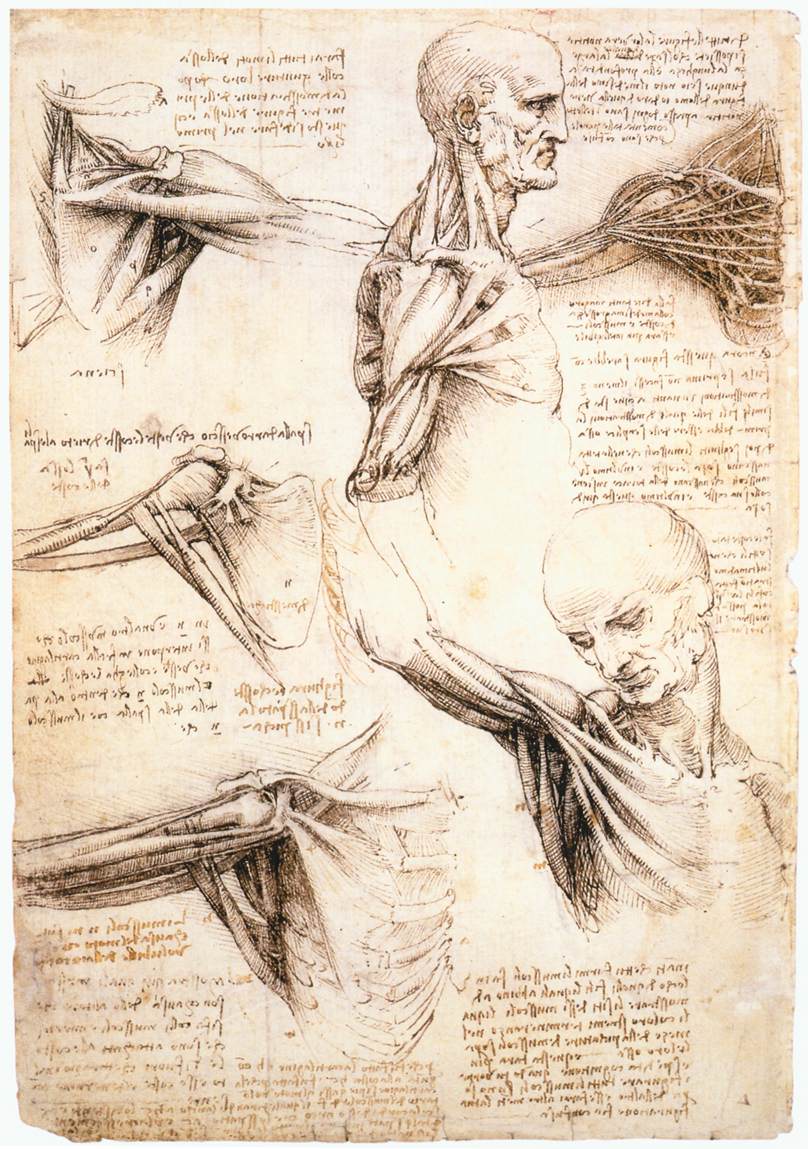
Anatomical studies of the shoulder, c. 1509–10
Leonardo da Vinci · Pen and ink over black chalk on paper
Research treated as a form of drawing: dissection notes, comparative views, and marginalia sharing the sheet — the notebook as studio.
Royal Collection Trust, Windsor · Source
Improvisation
To improvise is to relinquish the comforts of the blueprint in favor of a radical presence. While the Western tradition often lionizes the master plan—the meticulously gridded underdrawing, the preparatory cartoon, the calculated glaze—improvisation suggests that the most profound insights are not found in the anticipation of a work, but in the friction of its making. It is an argument for the intelligence of the hand over the caution of the mind. When an artist bypasses the stage of conscious judgment, they effectively silence the internal censor that rejects ideas before they have the chance to be born. In this state of flow, the process reveals itself incrementally; each mark is not a step toward a predetermined destination, but a question that the next mark must answer.
The history of the twentieth century offers a varied taxonomy of this approach, most notably in the Surrealist practice of automatic drawing. Figures like André Masson and the movement’s theorist, André Breton, sought a direct line to the unconscious by allowing the hand to move across the page without the interference of rational thought. The resulting biomorphic tangles and sudden, jagged incursions were seen not as "mistakes," but as transmissions from a deeper, unmanicured self. This was a move away from the "fine" arts and toward a psychological archaeology. Similarly, the calligraphic scribbles of Cy Twombly operate in a space of impulsive, child-like urgency. His loops and scratches reject the legibility of writing to capture the raw energy of the gesture itself—a kind of improvised shorthand for a state of being.
For others, improvisation is a matter of velocity. Speed serves as a necessary violence against hesitation. In the tradition of the thirty-second gesture drawing, there is no time for the ego to fret over anatomy or likeness; one can only hope to capture the essence of a form through pure instinct. Jackson Pollock’s action paintings took this to a systemic level, using the physical rhythms of the body, the viscosity of the paint, and the pull of gravity as collaborators. By dripping and flinging medium onto a canvas laid flat on the floor, Pollock moved the act of painting into the realm of dance. His work is less a "picture" of a thing than it is a temporal record of an event—a visual history of a series of spontaneous decisions made in the heat of momentum.
This method often necessitates a dialogue with what the uninitiated might call "accidents." A drip that runs contrary to a line, a smudge where a sharp edge was intended, or the unexpected way bleach reacts with a substrate are all opportunities for responsive improvisation. Rather than attempting to "fix" these moments—an act which usually results in a labored, defensive surface—the improviser incorporates them. They treat the flaw as a new theme in a jazz composition, an invitation to riff and redirect. This sensibility relies on a "call and response" relationship with the material. One does not dictate to the paint; one hears what the paint is doing and replies in kind.
However, pure spontaneity is rarely sustainable as a total philosophy. Even the most liberated improvisers usually operate within a framework of structured spontaneity, much like a musician improvising over a set chord progression. An artist might choose a restricted palette or a geometric constraint beforehand, then allow themselves total freedom within those boundaries. This tension between the grid and the ghost, or the structure and the impulse, is often where the most compelling work resides. It allows for the thrill of the new without the formlessness of the purely random.
To practice improvisation is, ultimately, to cultivate a capacity for "failing safely." It requires a willingness to treat the sketchbook or the cheap substrate as a laboratory where the stakes are low enough to permit wild experimentation. By trusting the first instinct and resisting the urge to second-guess, the artist keeps their intuition sharp. Not every improvised mark will lead to a masterpiece, but the habit of spontaneity ensures that when a moment of genuine grace arrives, the artist is fluid enough to recognize it and bold enough to follow where it leads.
Diagnostic questions: Try starting a piece with no plan and no reference — just the material and forty-five minutes. What did your hands do when your head wasn't steering? That's the practice underneath the practice.

Self-Portrait Leaning on a Stone Sill, 1639
Rembrandt van Rijn · Etching
Improvisation on copper: Rembrandt reworks his own face into the plate through multiple states, letting revision and afterthought remain visible as marks — the finished print is a record of thinking, not a fair copy.
National Gallery of Art, Washington · Source
Failure & iteration
Failure is the silent partner of every creative life, yet it is often treated as a crisis to be averted rather than a condition to be managed. The reality of the studio is that most work does not succeed. For the artist, learning to fail productively is not merely a psychological coping mechanism; it is a fundamental generative method. To avoid failure is to avoid risk, and to avoid risk is to ensure stagnation. As Samuel Beckett famously exhorted, the goal is not to eliminate error but to "fail better." When an artist reframes failure as data, the collapsed painting or the structural mess in the kiln ceases to be a personal indictment and becomes a vital report from the front lines of an ongoing investigation.
There are, broadly, four ways for a work of art to fail, each offering a distinct kind of instruction. The first is technical failure, where the materials themselves rebel. The paper tears under too much moisture, the pigments turn to mud, or the proportions of a figure collapse into unintended caricature. These are the most straightforward failures to diagnose and correct; they indicate a need for greater craft or a more intimate understanding of one’s medium. Technical problems have technical solutions, and their resolution is the primary labor of the apprentice.
More complex is the conceptual failure, in which a sophisticated idea simply fails to survive the transition into physical form. We have all experienced the "brilliant" concept that feels hollow once executed, or the realization that a premise was not as robust as it seemed in the sketchbook. Closely related is the aesthetic failure—the work that is technically proficient and conceptually sound but remains, stubbornly, boring or incoherent. It does not compel the eye; it lacks the necessary friction to hold a viewer’s attention. Finally, there is the failure of communication, where the artist’s intent and the viewer’s reception diverge so wildly that the work is misread or, worse, ignored entirely. In this instance, the artist must decide whether to provide better framing or to accept that meaning is a volatile substance, never fully under the maker’s control.
The Economy of Iteration
To survive these inevitable collapses, one must adopt strategies that lower the cost of failure. The most seasoned practitioners "fail small"—they test ideas in maquettes, thumbnail sketches, and cheap studies before committing to the grand canvas or the expensive casting. By making failure inexpensive, they make it permissible. There is a profound liberation in the "bad" work, the piece that is never intended for the portfolio but serves as a stepping stone. When a work fails, it should not be discarded in a fit of pique; it should be analyzed. To ask exactly where a composition failed is to prevent that specific mistake from recurring. Often, the failed work is the best raw material for the next; it can be cut apart, painted over, or recombined, its ruins providing the foundation for something more resilient.
This approach requires what Carol Dweck identifies as a growth mindset: the understanding that one is not "bad" at art, but rather "not good yet." This distinction is the difference between a career and a hobby. It allows for a necessary emotional distance, separating the worth of the person from the success of the object. If we look at the historical record, the definition of failure is frequently a matter of timing. Vincent van Gogh died considering himself a failure, having sold perhaps a single painting. Paul Cézanne was routinely mocked by critics and rejected by the Salon, labeled a madman by the very institutions he would eventually render obsolete. Claude Monet spent decades in financial desperation, his now-iconic light studies dismissed as mere impressions. Their success was not a lack of failure, but a refusal to let failure be the final word.
The Practice of Abandonment
In the daily rhythm of the studio, one must learn to normalize the failure rate. Some artists set "failure quotas," intentionally producing a high volume of work with the understanding that for every ten pieces, perhaps only one will possess the spark of life. This shifts the focus from quality—which can be paralyzing—to quantity, which is generative.
There is also a specific wisdom in knowing when to abandon a work. Not every failure is a salvageable "learning opportunity"; some are dead ends that simply need to be left behind so the artist can move on. Recognizing the difference between a productive struggle and a futile one is a mark of maturity. It can even be useful to intentionally pursue failure—to set out to make the "worst possible" work. By stripping away the pressure to be good, the artist often discovers a strange, raw energy that the pursuit of excellence had suppressed. Whether through salvage, documentation, or the vulnerability of sharing a failed work with a peer, the goal remains the same: to strip failure of its power to be ashamed, and instead use it as the fuel for whatever comes next.
Diagnostic questions: Keep the last piece that didn't work. Put it somewhere you'll see it for a month. What does it start to teach you once the sting is gone? The failures you throw out are the ones you're doomed to repeat.
Sources & further reading
For the shelf beside this part
Entries marked ⚑ anchor specific contested or checkable claims in the text.
Paragraphs on Conceptual Art / Sentences on Conceptual Art (Artforum, June 1967 / 0–9, 1969) — Sol LeWitt
Source of 'the idea becomes a machine that makes the art' — two texts, two years apart; the book cites the right one.
Silence (1961) — John Cage
Chance operations from the source.
Oblique Strategies (1975) — Brian Eno & Peter Schmidt
Constraints as playing cards.
Oulipo: A Primer of Potential Literature (1986) — Warren Motte (ed.)
The constraint tradition the methods chapter draws on.
Art & Fear (1993) — David Bayles & Ted Orland
The failure-and-iteration chapter's older sibling.
The Creative Habit (2003) — Twyla Tharp
Daily practice, without mysticism.