Part 02 · Field Book
Content & Meaning
What art is about — subject, symbol, narrative, emotion, idea, politics, and the personal.
This part is about what art is of and what it is about — the two questions that almost every viewer, no matter how untrained, ends up asking in front of a picture, and the two questions artists sometimes forget to ask themselves. Subject, symbol, narrative, feeling, idea, politics, and the personal: seven overlapping registers in which a work makes its meaning. None of them exhausts a strong picture; most strong pictures are working in several at once.
In this part · 7 chapters
Subject matter
Subject matter is the easiest thing to name in a painting and the hardest thing to see clearly. It is what the work is of — a bowl of lemons, a mother and child, a stretch of highway, a rectangle of red. But subject matter is never only what it depicts. It is a decision about where to look, and every decision about where to look is a decision about what is worth looking at.
For most of Western art's recorded history the answer to that question was fixed by patronage. The church wanted saints, martyrdoms, annunciations. Courts wanted battles, coronations, allegories in which the ruler stood as Mars or Apollo. The wealthy wanted themselves — in armour, in silk, beside their spaniels, holding the objects that proved their reach. A painter's subject was largely chosen before the painter arrived. What the painter contributed was tone, invention, and the private freight they smuggled into a public commission.
The great shift, uneven and much slower than the textbooks suggest, was the migration of subject matter from the given to the chosen. Dutch seventeenth-century painting is a fair place to date the change: still lifes of oysters and lemons, tavern scenes, small domestic rooms, land seen for its own sake. These pictures did not need a scriptural pretext. A herring on a pewter plate, painted with almost embarrassing seriousness, was allowed to be the whole subject. Once a herring could carry a painting, so — eventually — could a haystack, a bathhouse, a soup can, an unmade bed.
It is useful to hold a few of the historic categories in mind, not as a taxonomy to memorise but as a set of pressures a subject can exert on a viewer.
The figure. A body in a picture is never neutral. We are wired to find faces and to read posture; a figure will always draw the eye first and last. This is why figurative work carries such weight of tradition and such risk of cliché. The portrait, in particular, is a genre in which almost everything has already been done well, which means the standard for making a new one that matters is unusually high. What has kept portraiture alive is that each generation redefines what a face is asked to reveal: piety in Byzantine icons, status in Holbein, interiority in Rembrandt, class and psychology in Sargent, alienation in Freud, race and visibility in Kehinde Wiley and Amy Sherald.
Landscape. For a long time landscape was a backdrop for saints or shepherds. It became a subject when it began to carry weather, geology, and eventually national feeling — the Hudson River School's American sublime, Constable's damp English fields, Hokusai's Fuji seen nominally thirty-six ways (the series ultimately comprises forty-six prints) from different lives. Landscape is now the genre most quietly transformed by ecological crisis. To paint a glacier in 2026 is not the same act it was in 1826, and the strongest contemporary landscape work knows this.
Still life. The still life is the philosopher of the genres. Objects arranged on a table sit still for as long as we look and continue to sit still after we leave. The Dutch called their most elaborate ones vanitas — skulls, guttering candles, cut flowers already wilting — because the point was to make the viewer feel time passing across ordinary things. Morandi spent forty years painting the same handful of bottles and jars in the same corner of the same room; his subject was not the bottles, it was the small daily miracle of looking twice.
The everyday. Nineteenth-century Realism (Courbet, Millet) insisted that peasants ploughing and stonebreakers at work were as legitimate a subject as any general on a horse. This was not a modest claim. It was a political one, and it produced a lineage — Manet's barmaids, Hopper's diners, the American photographers of the 1930s, the domestic scenes of Alice Neel and Jenny Saville — that continues to argue for the seriousness of unremarkable life.
Abstraction. Abstract work is often said to have no subject. This is almost never true. A Rothko is of a threshold between two colours; a Pollock is of the recorded arc of an arm; an Agnes Martin grid is of attention itself. The subject in abstract work is usually a felt condition rather than a nameable thing, and the difficulty for the painter is that felt conditions are easy to gesture at and hard to hold.
The absent. Some of the strongest work of the last fifty years takes its subject from what has been removed. Rachel Whiteread casts the space under a chair or inside a house; Doris Salcedo fills furniture with concrete to memorialise the disappeared; Felix Gonzalez-Torres offers a pile of candies whose slow depletion is the death of a lover. Absence, once you notice it as an available subject, is everywhere.
When you sit down to choose what to make work about, the useful question is rarely what should I paint? It is what do I keep looking at when nobody is asking me to look? The answer is usually more specific and more embarrassing than the answer you would give in public — a particular kind of light in a particular kitchen, a family argument you have never resolved, a plant you have kept alive for eleven years. That is the subject. The genre is only the shape you pour it into.
A last note on obligation. There is a persistent worry, especially among younger artists, that some subjects are too small to deserve serious attention and others are too large to be approached honestly. Both worries are almost always overstated. Vermeer painted a woman pouring milk. Manet painted a bunch of asparagus. The smallness of the ostensible subject is not the measure of the work; the quality of attention is. And on the other side: nobody is required to make work about every catastrophe of their era. The obligation is to make work you can stand behind, in a form you have earned, about something you actually see.
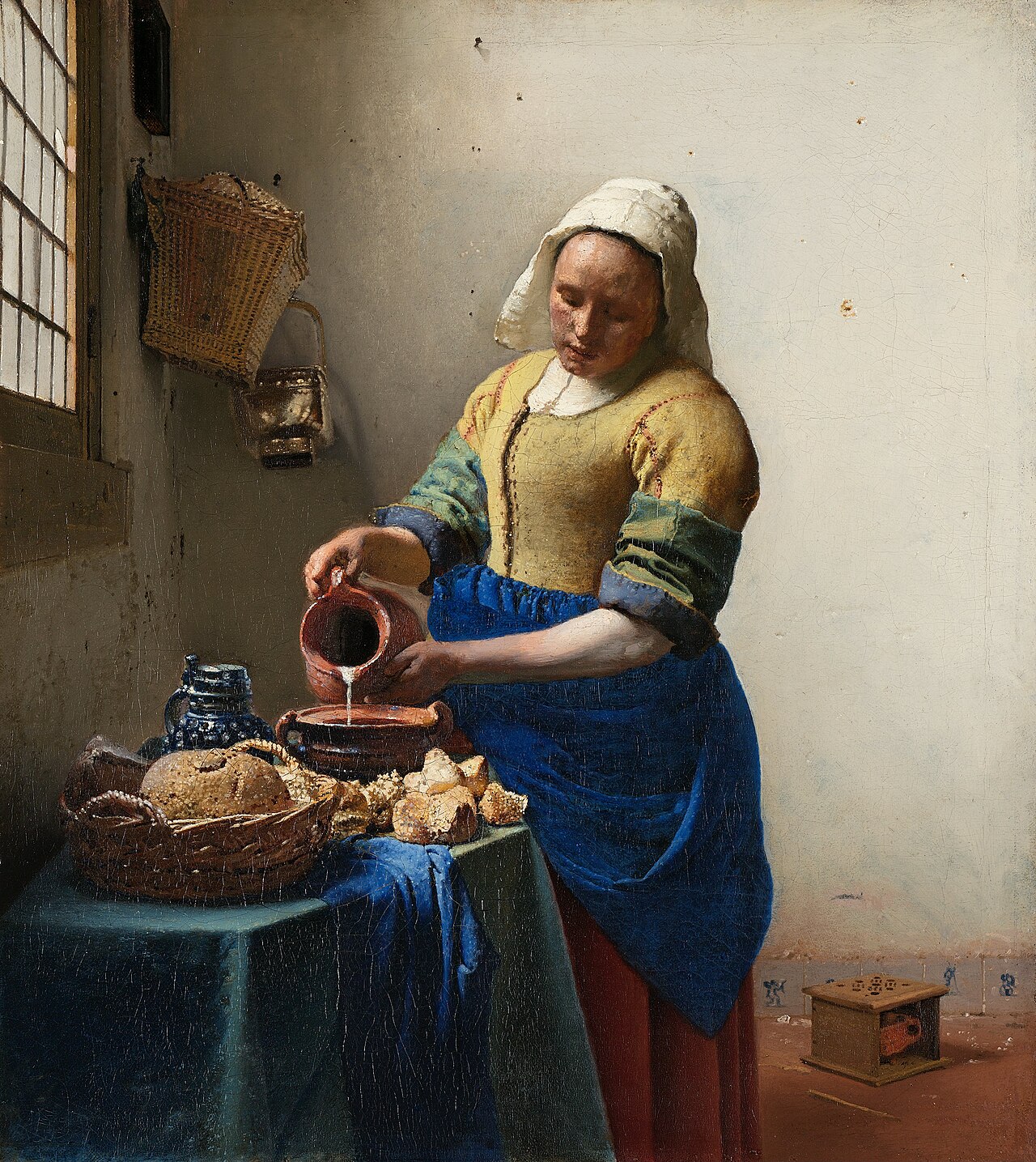
The Milkmaid, c. 1657–58
Johannes Vermeer · Oil on canvas
A small domestic action given the seriousness usually reserved for saints: the whole picture organised around one steady stream of milk.
Rijksmuseum, Amsterdam · Source

A Bunch of Asparagus, 1880
Édouard Manet · Oil on canvas
Proof that the ostensible subject need not be grand — a tied bundle of vegetables, painted with total attention, is enough.
Wallraf-Richartz-Museum, Cologne · Source
Diagnostic questions, for the work on the table: What is your picture of, in one plain sentence a stranger could repeat? Is that the subject you want, or is it the subject you defaulted to? And could a viewer name the subject without reading your title or statement?

Fine Wind, Clear Weather (Red Fuji), from Thirty-six Views of Mount Fuji, c. 1830–32
Katsushika Hokusai · Polychrome woodblock print
One mountain, thirty-six pictures: the subject is not Fuji so much as the discipline of looking at the same thing until each viewing becomes its own.
Los Angeles County Museum of Art · Source
Symbol, metaphor & analogy
A symbol is a shortcut that a culture has agreed to take together. A red cross means help; a skull means death; a dove with an olive branch means peace; a lotus, depending on where you were raised, means enlightenment or funerary respect or nothing in particular. Symbols are efficient. They allow a picture to say something without having to argue for it. They are also, for that same reason, easily exhausted. A symbol that everyone recognises is a symbol that has stopped doing much work.
The older traditions of Western art are dense with symbols the modern viewer no longer reads fluently. In a fifteenth-century Annunciation, the lily in the vase is the Virgin's purity, the closed garden behind her is her intact virginity, the single ray of light entering the window is the descent of the Holy Spirit, and the small dog at Mary's feet is fidelity. None of this is decorative. Each object is a sentence. The painting is, in a sense, a page of dense theological prose written in objects. Iconography — the discipline of reading these codes — was once a basic literacy. Now it is a specialism.
Contemporary practice tends to work at the far end of this spectrum, with symbols that are private rather than public. Louise Bourgeois's spider was Maman, her mother; it was not a general symbol of maternal care, and it does not become one when we learn what it meant to her. Frida Kahlo's ex-votos, her monkeys, her broken column: these belong to a personal cosmology that was legible to her before it was legible to anyone else. This is a legitimate and often powerful strategy, but it carries a cost. Private symbols require the viewer to be taught, either by wall text or by biography, and the teaching can crowd the painting.
Between the public code and the private cipher sits the metaphor. A metaphor is a symbol still in motion — an object standing in for something it partly resembles, without either side collapsing into the other. Kiki Smith's figures made of paper and wax are not symbols of fragility; they are fragile, and their fragility is doing the same work the concept of fragility would do. Doris Salcedo's furniture, fossilised in concrete, is not a symbol of the disappeared; it is a piece of domestic life that can no longer be used, and the uselessness is the argument. The distinction matters because a metaphor keeps the object honest. A rose can stand for love without ceasing to be a rose. A symbol, at its weakest, is a rose that has become embarrassed to be a rose.
The pitfall in this whole area is over-explanation. Young artists frequently load a painting with symbols and then write a statement announcing what each symbol means. This is almost always weaker than either of its halves. If the symbols work, the statement is unnecessary; if they don't, the statement cannot rescue them. A better working rule is to let each image do one thing that matters and then stop. If the crow is death, do not also make the sky bleed. If the sky bleeds, the crow can be a crow.
Analogy is subtler again. Analogy is the way a whole picture can be like something without depicting it. Rothko's late paintings are analogies for the experience of standing at a threshold. Agnes Martin's grids are analogies for the quality of attention required to see them. This is the least teachable of the three modes and the most durable, because analogy resists translation. You cannot summarise it. You have to stand there.
Diagnostic questions, for the work on the table: If you removed your artist statement entirely, what is the single most legible metaphor still standing in this work? Is your object allowed to just be an object, or is it buckling under the weight of what you have asked it to represent?
Narrative structures
Every picture contains time, whether or not it means to. A single figure walking through a doorway is a before and an after held in one frame; a still life of half-eaten bread implies the meal that preceded it and the room that will empty after. The question for any artist working with narrative is not whether time is present but how much of it to admit and how openly to organise it.
The oldest narrative device in visual art is the single significant moment. Renaissance painting inherited it from classical rhetoric: choose the instant in a story at which everything before is implied and everything after is inevitable. Caravaggio's Calling of Saint Matthew is the model. Christ has entered; his hand is raised; Matthew has half-turned; the coins are still on the table. The moment is the hinge. If the painter had chosen the instant just before, nothing would be happening. Just after, everything would be over. This kind of choice is a form of dramaturgy, and it is worth practicing even outside religious subject matter — the instant a conversation turns, the instant a room notices a new arrival, the instant weather changes.

The Calling of Saint Matthew, 1599–1600
Caravaggio (Michelangelo Merisi) · Oil on canvas
The hinge moment: the hand is raised, the head half-turned, the coins still on the table. A single instant carries everything before and after it.
Contarelli Chapel, San Luigi dei Francesi, Rome · Source
A second tradition, older in Asia and revived in the twentieth century in comics and film, is the sequence. A handscroll unrolled by a single viewer moves through a landscape at reading pace; a predella beneath an altarpiece lays out the life of a saint in five panels; a comic page distributes a fight across six panels of varying width. Sequence introduces the possibility of pacing — a small panel is a beat, a wide panel is a held breath, a black panel is silence. Any artist making a series of related images is working, whether they admit it or not, in this tradition. A gallery wall is a sequence. A book is a sequence. An Instagram grid is a sequence, and a bad one.
The twentieth century added the fragment. Modernist painting largely refused single-moment storytelling — Cubism showed a violin from six angles at once, Futurism dragged motion across the canvas as blur, Bacon painted screaming popes whose faces were already dissolving. The claim was that the older single-moment convention was a fiction the eye did not actually experience, and that a truer picture would admit its own discontinuity. This is now standard vocabulary. It is also, at its weakest, an excuse for pictures that do not resolve because the artist did not know how to resolve them.
A fourth mode, quieter, is implied narrative — the picture that suggests a story without telling one. Hopper is the master. In Nighthawks nothing is happening: three customers and a counterman in a late diner. But the picture is full of what has not been said. Who are the man and woman? Are they together? What did they say to each other on the walk over? Hopper never answers because the picture is not interested in the answer; it is interested in the atmosphere in which such an answer would be given. Implied narrative is the strongest option available to painters who do not want to illustrate but do want their pictures to feel inhabited.

Nighthawks, 1942
Edward Hopper · Oil on canvas
Implied narrative in its purest form: nothing is happening, and everything unspoken has room to occupy the picture.
The Art Institute of Chicago · Source
Finally there is the anti-narrative, work that actively refuses to be read as a story. A minimalist grid, a monochrome, a large field of blue — these say, in effect, that there is nothing to follow and nothing to work out, only something to be in front of. This is not narrative failure; it is a different address. It asks the viewer to stop reading and start looking. Many viewers, trained by film and by wall text, find this address difficult. That is a feature of the work, not a bug.
When you find yourself unsure what your own picture is doing narratively, the diagnostic question is simple: what does the viewer do with time in front of it? If the answer is read left to right, you are in the sequence tradition. If the answer is reconstruct what happened, you are in the Caravaggio tradition. If the answer is stand still and wait, you are with Hopper or Rothko. All four modes are legitimate. Trouble arrives when a picture is trying to do two of them at once without knowing it.
Diagnostic questions, for the work on the table: What does the viewer do with time in front of this picture — read it left to right, reconstruct what has just happened, or stand still and wait? Is that the mode you intended, and are you accidentally asking for two modes at once?
Emotional content
Emotion is the register in which most viewers, most of the time, actually experience art. They do not first identify the iconography or reconstruct the compositional grid. They stand in front of the work and something in the body responds — a small lift, a wariness, a tightening at the base of the throat — and only afterwards, if at all, do they try to give the response a name. Any theory of visual art that leaves out this pre-verbal transaction is incomplete.
There are, broadly, two ways of putting emotion into a picture. The first is to declare it. The second is to let it accumulate.
Declared emotion is the mode of Expressionism, in the widest sense — the German painters of the early twentieth century, the Abstract Expressionists of the mid-century, the Neo-Expressionists of the 1980s, and their many descendants. Munch's Scream is the canonical case: the figure is screaming, the landscape is screaming, the sky is screaming, the frame would be screaming if it could. Nothing is held back. Pollock's drips are similarly unequivocal — they are the visible record of a body in a state, and the state is not tranquillity. Rothko is a subtler case within the same tradition. He wanted, and said he wanted, viewers to weep in front of his paintings, and enough of them have done so over the years that the ambition cannot be dismissed. Declared emotion works when the artist has committed fully. It fails, embarrassingly, when the commitment is only partial — a half-hearted Expressionist painting reads as decor with a raised voice.
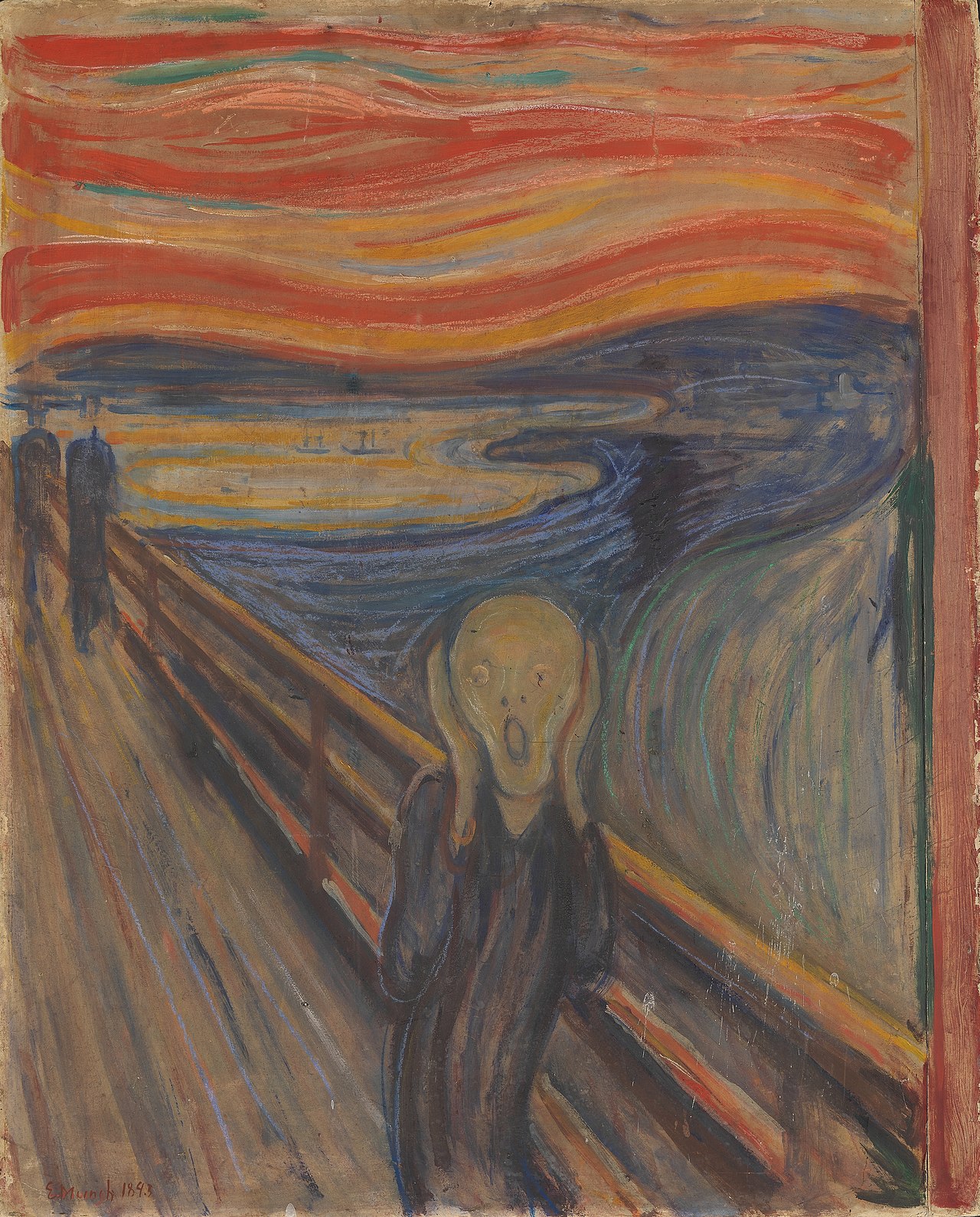
The Scream, 1893
Edvard Munch · Oil, tempera and pastel on cardboard
Declared emotion without reserve: figure, sky, and bridge all pitched to the same frequency, so that nothing in the picture is calm.
National Gallery of Norway, Oslo · Source
Accumulated emotion is quieter and, when it works, more durable. Vermeer painted women engaged in small domestic acts — pouring milk, reading a letter, weighing pearls — and did not tell you what to feel about them. The feeling accrues because of the light, because of the pause, because of the way a wall is empty for most of its height and then holds a single nail. Hopper works the same way; so does Morandi; so, in a very different key, does Agnes Martin. In accumulated work the emotion is not in any single element. It emerges from the whole and is difficult to point to, which is part of why it survives repeated viewing. There is nothing to use up.
A third mode is worth naming: withheld emotion. Some of the strongest work of the last half-century has taken as its subject the refusal to give the viewer the feeling they came for. Gerhard Richter's blurred photographs of the Baader-Meinhof dead do not mourn, do not accuse, do not commemorate; they hold the images at a distance the viewer has to close on their own. Doris Salcedo's monuments to political violence are almost silent — a crack across a museum floor, chairs cemented into a wall. This is not coldness. It is a bet that the viewer, given the space, will supply a stronger feeling than the artist could have imposed.
There are two failure modes to watch for. The first is sentimentality — emotion pitched slightly above what the picture has earned. Sentimentality is not a moral failing; it is a calibration error. A picture asks for a tear and has only paid for a small sigh. The correction is almost always to remove something rather than to add. The second failure mode is coldness that mistakes itself for restraint. Restraint works only when the viewer can feel the pressure of what has been left out. A painting that has withheld everything, including its own reason for existing, is not restrained; it is empty.
The most useful discipline for artists working seriously with emotion is to notice, honestly, what they feel while making. Not what they hope the viewer will feel — what they themselves feel, in the room, at the moment of the mark. Real feeling in the maker tends to translate. Manufactured feeling almost never does. This is unfair, because it means the shortest route to emotional work is also the longest: you have to be paying attention to your own inner weather, and then you have to be willing to leave the traces of it on the surface where anyone can see them.
Diagnostic questions, for the work on the table: Are you declaring the emotion, accumulating it, or withholding it? Does the feeling on the surface match the actual, honest feeling you had in your body while making the marks — or is it the feeling you thought the work was supposed to have?
Idea and process as content
There is a tradition, less than a century old but by now fully absorbed into the mainstream, in which the idea of the work is the work, and the physical object is only its residue. The nominal starting point is Duchamp — the urinal signed R. Mutt in 1917, submitted to an exhibition that could not decide whether to hang it. The claim was that the artist's decision to designate something as art was itself the act of making it, and that craft, skill, and beauty were optional additions rather than the thing itself. This was a scandal at the time and is now taught in first-year seminars, which is a fair measure of how thoroughly the argument won.

Fountain, 1917
Marcel Duchamp (photograph by Alfred Stieglitz) · Porcelain readymade (original lost; documented in Stieglitz's photograph)
The gesture that reset the terms: designation as the artistic act, and the object reduced to its documentation.
Documented at 291 gallery, New York · Source
Conceptual art in its stricter, 1960s and 1970s sense pushed the position further. Sol LeWitt wrote in his Paragraphs on Conceptual Art that the idea becomes a machine that makes the art; the execution is a perfunctory affair. His wall drawings were sold as sets of instructions, to be realised on any wall by any competent draftsperson. Lawrence Weiner offered sentences — A 36" x 36" REMOVAL TO THE LATHING OR SUPPORT WALL OF PLASTER OR WALLBOARD FROM A WALL — as complete works, whether or not anyone ever cut the square. Joseph Kosuth exhibited a chair, a photograph of the chair, and a dictionary definition of chair, and asked which of the three was actually the art. The answer, he argued, was the question itself.
The strength of this tradition is that it opened the door to work that would otherwise have had nowhere to go — performance, instruction pieces, land art, most of what we now call installation. The weakness, visible almost immediately, is that an idea by itself is thin. Ideas summarise well. That is what they are for. A summary of a good Rothko does not replace the Rothko, but a summary of a mediocre conceptual work replaces it entirely, which is why so much of the movement's second and third generation has aged so poorly. If the whole of the piece can survive as a caption, the piece was probably always a caption.
The more productive descendants of the conceptual turn are the artists who took the emphasis on idea and applied it to process. Process art proposes that what the work is about is the record of how it was made. Richard Serra's early lead-splash pieces — molten lead thrown into the corner of a room, cooled, and left where it landed — are not depictions of a process; they are the process itself, still visible. Eva Hesse's latex and fibreglass sculptures show, without hiding, the accidents of their fabrication. On Kawara's date paintings — one small canvas per day for decades, each showing only that day's date, and each destroyed if not finished by midnight — are less about the individual painting than about the accumulated proof of a life spent making them.
The useful principle, for a working artist, is that idea and process are two of the several possible loads a picture can carry, not the only one and not the most important. A piece can be conceptually thin and materially strong, or conceptually strong and materially indifferent, and both can be good. What almost never works is a piece that is thin in both directions and hopes to be rescued by the artist's statement.
A related pitfall is worth naming. There is a persistent style of contemporary work that presents itself as about something — capitalism, labour, memory, translation — without doing anything to that something that could not have been done by an essay. If the piece is only illustrating an argument that already exists, and the argument would be better made in prose, the honest response is to write the essay. Visual art earns its keep when it does something that only a visual object, in a room, in front of a body, can do. The idea can be the reason for making the object; it should not be the object's only excuse for being there.
Diagnostic questions, for the work on the table: Could the idea in this piece be more fully carried by an essay, a diagram, or a conversation? If yes, what does the physical object add that those forms cannot? What is here that only a visual object, in a room, in front of a body, can do?
Personal expression
The romantic idea that art is the outward expression of an inward self is younger than it feels. For most of Western history painters were craftsmen, working to commissions, and the concept of an artistic personality that the paintings were expressions of would have puzzled them. Van Eyck painted whatever the guild or the patron required, superbly. What has changed, roughly since the late eighteenth century, is that the person of the artist has become part of what the work is understood to be of. A Van Gogh is a Van Gogh partly because we cannot help knowing about the letters, the ear, the asylum, the yellow rooms. Whether this is a gain or a loss for the work itself is arguable; that it has happened is not.

The Arnolfini Portrait, 1434
Jan van Eyck · Oil on oak
A commission executed with total craft: the artist's personality is present only as competence and attention, not as confession.
The National Gallery, London · Source
The temptation, for a young artist working in this inheritance, is to conclude that authenticity is the whole game — that the more nakedly personal the work, the more it must be worth. This is not true, and the evidence is everywhere. There is a great deal of thoroughly personal work that is also thoroughly boring, because the person in question has not yet had experiences interesting enough, or has not yet developed the craft to render the experiences they have had. Sincerity is a necessary condition of good personal work. It is not a sufficient one.
The stronger claim, and the one that survives contact with the actual history, is that specificity travels. The paintings that read as most universal are almost always paintings that started somewhere very particular. Frida Kahlo's The Two Fridas is not a general statement about identity; it is a picture of her own body after a specific divorce. It reads more widely because it did not try to. Louise Bourgeois's spiders are her mother. Alice Neel's portraits are of people she actually knew and had opinions about. The generality is a side effect. The primary act is the local one.
There is a useful practical exercise, sometimes called mining specificity, that most artists learn eventually. It goes like this. Instead of trying to make a painting about grief, make a painting about the third day after your grandmother's funeral, when you found her reading glasses in a jacket pocket. Instead of a painting about immigration, a painting about the fluorescent light in the specific consular office. Instead of a painting about queerness, a painting about the twenty minutes before a specific first kiss. The specific is harder to write and easier to see, and it protects the artist from the largest failure of personal work, which is the failure of falling back on categories the viewer already knows how to feel about.
A second discipline is worth mentioning: permission. Many artists carry around a private list of subjects they consider off-limits — too small, too embarrassing, too domestic, too involved with people whose feelings need protecting, too far from the kind of artist they wish they were. This list is almost always where the best work is. This does not mean every private difficulty should be strip-mined for material; it means the artist should notice which subjects they habitually refuse and ask, honestly, whether the refusal is ethical or merely defensive.
A note on privacy. Personal work has costs, and not all of them fall on the artist. If your painting is about your mother, your mother will see it. If your video is about a former partner, they may see it too, and they did not consent to being material. The tradition contains cautionary examples in both directions — artists who protected too much and produced generic work, and artists who protected too little and did real harm. There is no clean rule. What there is, is a habit of asking the question before the piece is finished rather than after it has been hung.
The last thing worth saying about personal expression is that it is not the only serious option. The idea that art must be a confession, and that anything less is a failure of nerve, is itself a period style — a nineteenth- and twentieth-century inheritance that a twenty-first-century artist can accept, modify, or refuse. Some of the most alive work now is deliberately impersonal — the artist as researcher, as curator of found material, as convenor of collaborations, as maker of systems that then run themselves. The self can be the subject; it does not have to be. The only real requirement is that whatever the work is of, the artist has been genuinely present to it, and has left a trace of that presence on the surface where the viewer can find it.
Diagnostic questions, for the work on the table: Where in this piece is your own life actually present, and where have you substituted a generalisation for a specific? If a stranger who knew nothing about you stood in front of the work, would they feel someone had been here — or only that a subject had been handled?
Sources & further reading
For the shelf beside this part
Entries marked ⚑ anchor specific contested or checkable claims in the text.
Ways of Seeing (1972) — John Berger
Subject matter, the nude, property, and publicity; still the best first book on meaning.
Studies in Iconology (1939) — Erwin Panofsky
The classic method for reading symbols historically.
Mythologies / Camera Lucida (1957 / 1980) — Roland Barthes
How images mean more than they show.
On Photography (1977) — Susan Sontag
Attention, appropriation, and the ethics of looking.
Six Years (1973) — Lucy Lippard
The primary document of idea-as-content.
Social & political commentary
Art has been used to argue with power for as long as it has been used to flatter it. Goya's Third of May is a protest picture; so are Käthe Kollwitz's mothers with their dead children, Picasso's Guernica, Ben Shahn's Sacco and Vanzetti pictures, the AIDS Coalition to Unleash Power's Silence = Death poster, Nan Goldin's photographs against the Sacklers, Kara Walker's silhouettes of American plantation life. This is a long, honourable, and difficult tradition, and it is worth being honest about what it can and cannot do.
The Third of May 1808, 1814
Francisco de Goya · Oil on canvas
A picture that survives its politics because it is formally serious first: the geometry of light and gesture would hold even if the history behind it were forgotten.
Museo del Prado, Madrid · Source
Mother with her Dead Son (enlargement, Neue Wache, Berlin), 1937–38 / installed 1993
Käthe Kollwitz · Bronze after Kollwitz's small sculpture
Political grief without slogans: a body folded around another body, offered as the whole of the argument.
Neue Wache, Berlin · Source
What political art can reliably do is make visible. Kollwitz did not end poverty. She did make it more difficult for a certain class of viewer to pretend they had not seen it. Goldin did not undo the opioid crisis. She did put the Sackler name back on a museum wall in a way the family could not easily buy off. The moral work of political art is largely the work of preventing forgetting. This is not a small thing. Most historical injustice has been protected as much by turned heads as by active malice, and any work that turns a head back has done something real.
What political art cannot reliably do is persuade the opposed. A viewer who arrives already in agreement will feel their agreement confirmed and possibly deepened. A viewer who arrives opposed will, in most cases, leave opposed. This is not because visual art is weak — it is because persuasion is hard, and because the viewers most in need of persuading are the least likely to walk into the room. The honest ambition of most political work is not conversion but consolation, memorialisation, and the maintenance of a moral vocabulary in circumstances that would prefer to lose it.
There is a particular failure mode that political work is prone to, and it is worth naming plainly. It is the failure of the work that is only about its subject — that has correct politics, an urgent topic, and a public statement, and that as an object does nothing an op-ed could not do more efficiently. Correct politics do not make a picture. They are a precondition, at best, and often not even that. The pictures that have lasted from the tradition — Goya, Kollwitz, Picasso, Shahn, Walker — are all, first, formally serious. They would be looked at even if the viewer did not agree, and they hold up on the third viewing as well as the first. This is what political work has to earn in order to keep working politically.
A second pitfall is the ventriloquism problem. It is one thing to make work about a community you belong to; it is another to make work about a community whose suffering you are borrowing. The line is not always bright, but the question the honest artist asks themselves is: whose picture is this, and who benefits from it existing? If the answer is uncomfortable, the work needs either a change of subject or a change of hand.
There is a third position worth naming, older than either of the above: the artist who declines the political brief entirely, on the grounds that the studio is one of the few remaining places in modern life where the demand to have an opinion can be refused. Morandi lived through fascism and painted bottles. Agnes Martin left New York for New Mexico and painted grids. This is not a cowardice. It is a claim that certain kinds of attention are themselves scarce goods and that maintaining them is a public service, however oblique. The claim can be abused as an excuse, but it can also be, and often has been, true.
The working artist does not have to choose the tradition of engagement or the tradition of withdrawal in the abstract. They choose it picture by picture, and often reverse the choice between projects. The only requirement is not to lie about which one you are doing.
Diagnostic questions, for the work on the table: Whose picture is this, and who benefits from it existing? If a viewer fundamentally disagreed with your politics, would the formal life of the work still give them a reason to keep looking — or is the picture only legible to those who already agree?